Cultural heritage, local knowledge and the assets communities already hold
By Tamar Dekel, with Philemon Nyamanga
What is lost when a calabash is replaced by a plastic container?
At first glance, perhaps very little. Both can hold water. Plastic may be cheaper, more convenient and easier to replace. Societies change, technologies change, and development certainly does not mean returning communities to the material culture of the past.
But during “Who Owns Culture? Localization, Restitution & the Power of Narrative,” a conversation at the Shifting the Center forum in Nairobi, this simple example opened a much larger question: when an object disappears, what knowledge disappears with it?
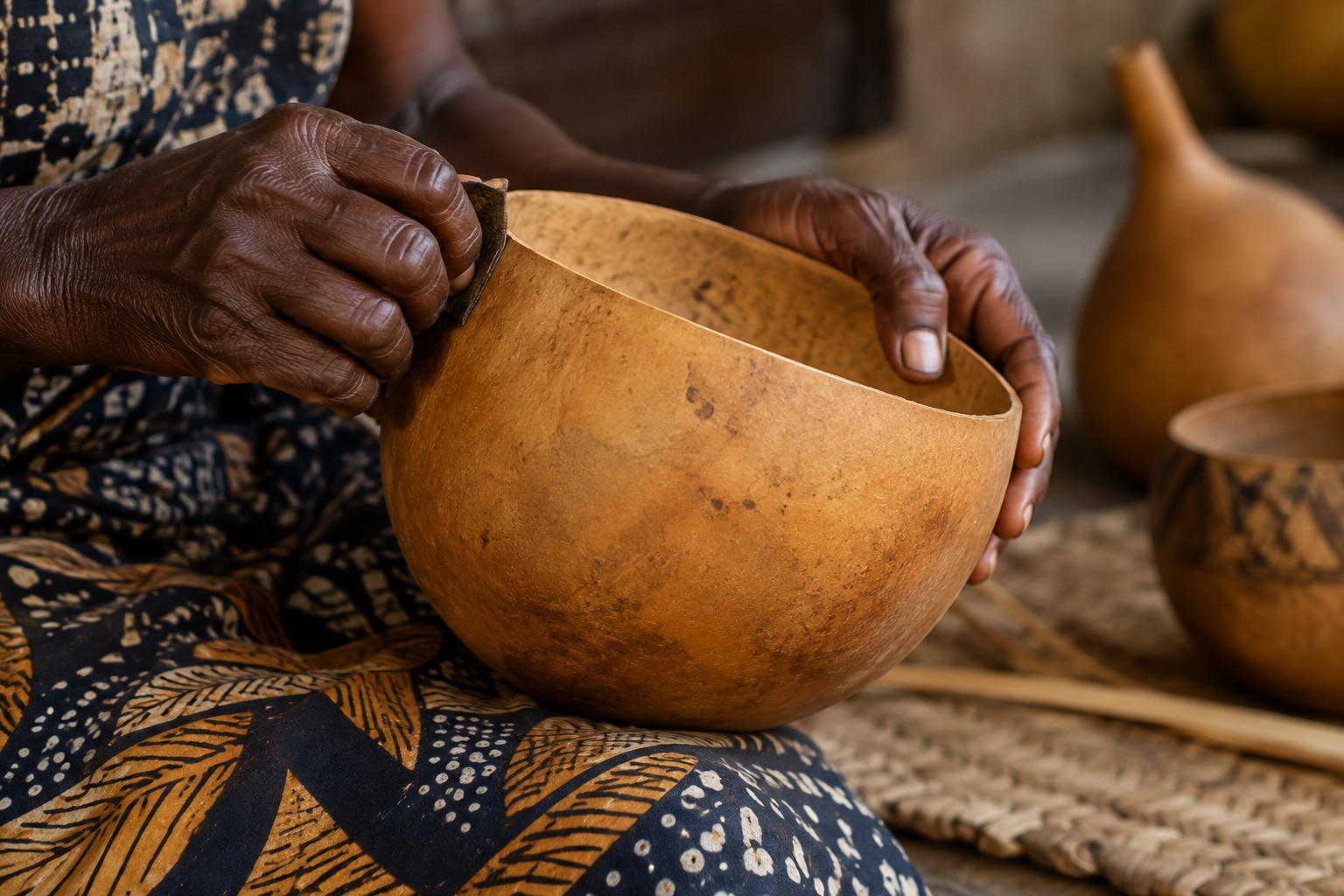
The person who once made the calabash knew the material, where it came from and how to work with it. The object was connected to local skills and production, to ways of storing water or preparing food and medicine, and to knowledge passed between generations. Replace enough locally made objects with things produced somewhere else, and the change is not only material. A community may gradually lose some of its capacity to make, repair and produce for itself.
And that makes cultural heritage a development question.
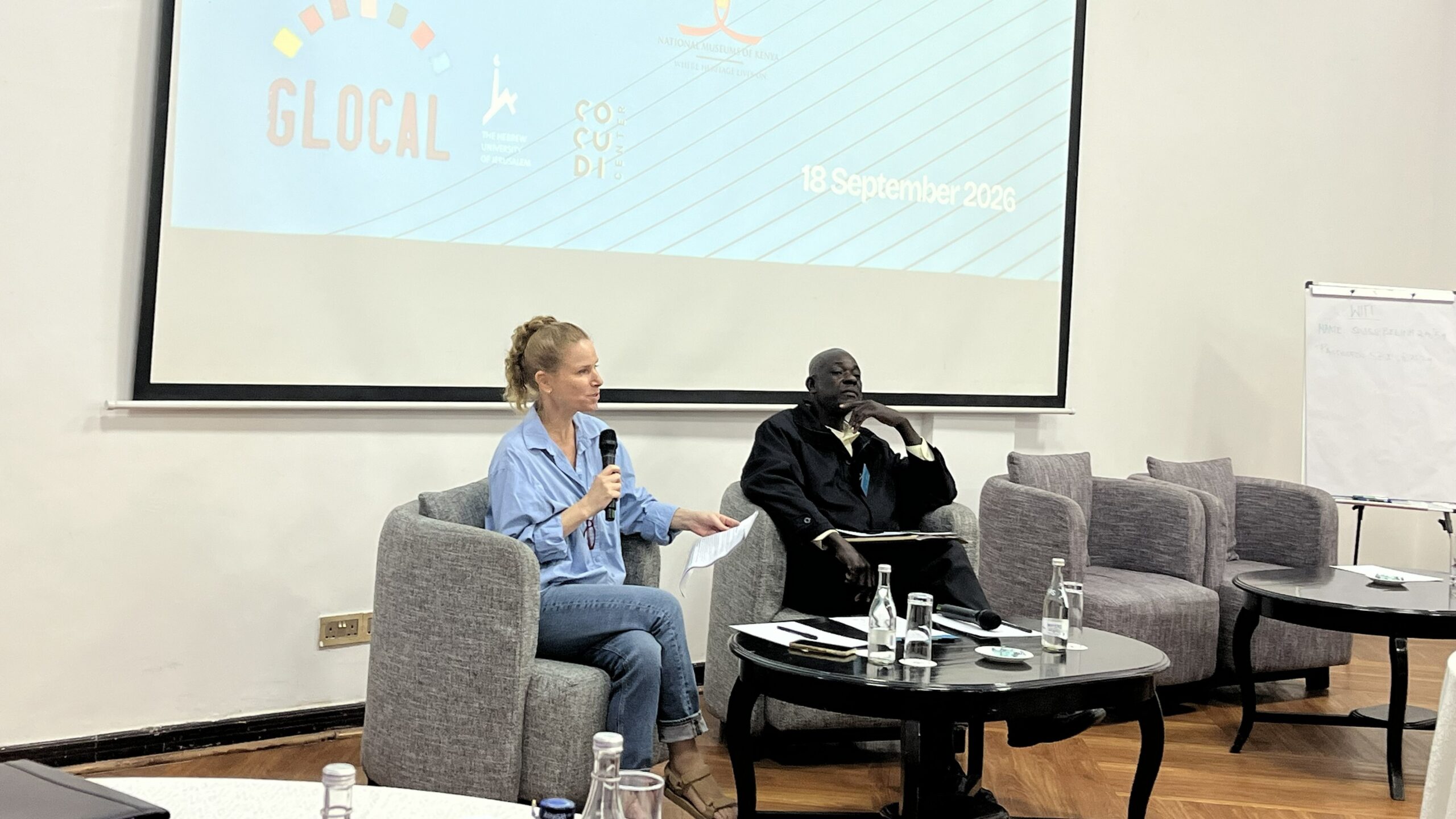
The conversation brought together Tamar Dekel, Founding Director of CoCuDi Center, and Philemon Ochieng’ Nyamanga, an anthropologist and heritage researcher and Head of the Cultural Heritage Department at the National Museums of Kenya. It began with the language of localization, familiar to development practitioners as a discussion about where resources flow, who makes decisions and whether local organizations have meaningful authority. But localization can also raise another set of questions: Who creates knowledge? Who has the authority to interpret it? Who retains skills? And who passes knowledge to the next generation?
For Nyamanga, language offers a particularly powerful example. Language is not simply a means of communication; it is a vehicle through which knowledge travels. When a language disappears, knowledge encoded within it can disappear too. The same is true of heritage more broadly. Some heritage is tangible—objects, buildings and places. Some is intangible—skills, beliefs, rituals, oral histories and ways of organizing social life.
For decades, states and cultural institutions have often assumed responsibility for preserving and interpreting this heritage. Yet the knowledge on which those institutions depend originates largely with communities themselves. Museums may act as trustees and professional custodians, Nyamanga argued, but communities remain essential knowledge holders and interpreters of their own heritage. Localization, seen from this perspective, is not simply about bringing resources or institutions geographically closer to communities. It is also about where knowledge and authority reside.
Reclaiming more than objects
This becomes particularly visible in debates around restitution. Calls for the return of African cultural objects held in European and other foreign collections have placed ownership at the center of international debate. But physical return, Nyamanga argued, is only one dimension of what has been lost.
Every object has a biography. How did it leave? What did it mean to the people who made and used it? What knowledge surrounded it? An object regarded elsewhere primarily as an artwork may have cultural or spiritual meanings that cannot be understood independently of the community from which it came.
Reclaiming heritage is therefore about more than moving an object from a museum abroad to a museum at home. Nyamanga describes this through what he calls the “Five Returns”: the return of the object, ownership, knowledge, authority and relationship. Restitution, in this broader sense, is also about reconnecting objects with the people, stories and systems of knowledge that give them meaning.
But this raises another question. What about heritage that disappears without ever being physically removed?
Nyamanga pointed to the traditional granary. When a granary disappears, we do not simply lose a type of building. We may also lose knowledge about construction, local materials and food preservation. Environmental change complicates the picture further, as grasses, timber and other materials once readily available may themselves have become scarce or expensive.
The same is true of the calabash. Calabashes, clay pots, woven baskets and other locally made utensils have increasingly been replaced by industrially manufactured products. There is nothing inherently wrong with that transformation. New products can improve lives, and cultures have always borrowed, adapted and changed. The issue is whether we recognize what else may be disappearing along the way.
When locally produced objects vanish, so may the skills required to make them. Local producers can lose markets, knowledge of materials can weaken, and younger generations may never learn techniques previously transmitted through practice. As local systems of production disappear, dependence on externally produced goods can grow. Heritage, sustainability and economic resilience begin to intersect.
Not a return to the past
Recognizing this loss does not mean romanticizing tradition. Not every historical practice should survive, and not every traditional material is appropriate for contemporary life. As Nyamanga emphasized throughout the conversation, culture is dynamic.
The more useful question is how communities themselves participate in deciding what to retain, what to adapt, what to recover, what to leave behind and what to create anew. A traditional skill might find a contemporary application; indigenous environmental knowledge might contribute to sustainable resource management; an older design might inspire a new product; oral traditions can find new life in digital forms.
Reclaiming heritage can therefore be forward-looking. The past becomes not a model to reproduce, but one of the resources available for imagining the future.
This is also why cultural heritage matters to development practitioners.
Nyamanga recalled housing interventions in which outsiders identified inadequate housing, designed what appeared to be better homes and assumed the problem had been solved. Yet technically appropriate designs could fail because they did not reflect how families actually organized their lives—for example, cultural expectations around whether different adult generations and their spouses shared the same dwelling.
A building can be technically sound and still be socially unusable. Cultural understanding is therefore not an ornamental addition to development. It can determine whether an intervention actually makes sense within the society in which it is introduced.
Nyamanga’s advice to practitioners was remarkably simple: begin with a conversation.
Rather than arriving with the answer, bring the challenge to the community. Ask what systems already exist, what people know, what has worked before and what has changed. In food security, for example, the appropriate contemporary solution may not be to reconstruct an old granary. But understanding the knowledge behind traditional systems of food storage can change the questions we ask when designing something new.
What is already here?
This brings us back to localization.
Development often begins by identifying deficits: what a community lacks, what needs to be fixed and what resources need to be brought in. But what if the starting point were different?
What is already here?
What knowledge, skills and materials? What relationships and memories? What cultural identities and ways of understanding the environment?
These, too, are development assets.
Development can strengthen them, connect them with new knowledge and create new opportunities around them. But it can also unintentionally weaken or displace them. A community whose knowledge and capacities are taken seriously enters a development process differently from one treated primarily as a recipient of outside expertise.
This does not mean that all inherited knowledge should be preserved unchanged. Some practices may no longer be useful, others may need to evolve, and still others may have been lost and deserve to be rediscovered. The task is not to freeze culture, but, in Nyamanga’s words, to walk with communities, allowing them to help determine which knowledge and practices can contribute to the challenges they face today.
Perhaps this is another meaning of shifting the center. Localization is not simply about moving money, organizations or decision-making closer to communities. It is also about shifting where we look for expertise, knowledge and possibility.
Before asking “What can we bring?”, perhaps we should begin by asking:
What is already here—and what can we build from it?
This article is based on “Who Owns Culture? Localization, Restitution & the Power of Narrative,” a conversation between Tamar Dekel and Philemon Nyamanga held during Shifting the Center: Localizing Impact through Leadership, Culture, and Collaboration in Nairobi in September 2026. It has been edited and developed from the recorded conversation and Nyamanga’s accompanying written reflections.